Cycles:
Historically cycles were one of the early forms of animation through a device called the zoetrope where a spinning cylinder gave the impression that still drawings were in fact moving, of course the drawings then had to tell a repetitive story due to the nature of the zoetrope.
Cycles in animation today have their uses for such things as walk and run cycles, and many other actions to do with movement. However it is popular to also create cycles that are morphs, possibly due to the limitations a cycles narrative presents, a morph can overcome these issues.
Staging:
How a scene is staged is very important to the overall story and how the audience perceives characters and the plot. A scene may have a lot going on in and around it but it is important for the animator to choose what to focus on as that is what the audience is going to see and perceive. It can cause elements of surprise to the storyline as the camera can focus on one thing, yet cut to another unexpected. It is important to consider what is included in the scene and how this can affect the audience emotion, for example shadows usually cast suspense and lightning can portray fear or horror.
Staging is usually not true to reality as the animator has to stage the characters at angles they would not be in; for example to converse they would probably be set at 3/4 angles to each other but this is so the audience can read emotion and expression.
Straight Ahead and Pose to Pose:
Straight ahead animation is usually spontaneous and fresh as the lack of control can help keep the whole process of drawing one frame straight after the other very creative as new ideas can be added as the animator goes along. However it is hard to judge the timing of the piece because of the lack of control, and in scenes where the layout or the background is busy, the technique will not work as it is hard to match the detail.
Pose to pose animation is carefully planned out, drawing key frames first and relating them to each other in size and action, the inbetweens are then filled in afterward. Scenes are always easy to follow because of the careful consideration, timings can be planned perfectly in the sense that the pattern of movement consists of short sharp movements as well as smooth flowing ones. However this of course takes time and resources, the downfall compared to straight ahead animation being that if a better idea is considered, it cannot be added as the scene has already been planned out.
Combining the two processes together is a winning combination, the pose to pose technique stops the straight ahead action from getting out of hand whilst keeping spontaneous. The use of all the other principles is very important to pose to pose action, such as timing and secondary action as it was these that developed the technique. Historically before the principles were developed, animators used to draw only in the straight ahead method and were only concerned with entertaining actions and the visuals.
Showing posts with label cycles. Show all posts
Showing posts with label cycles. Show all posts
Thursday, 6 January 2011

Flash Project
Here is an explanation of the principles I have used to create this piece.
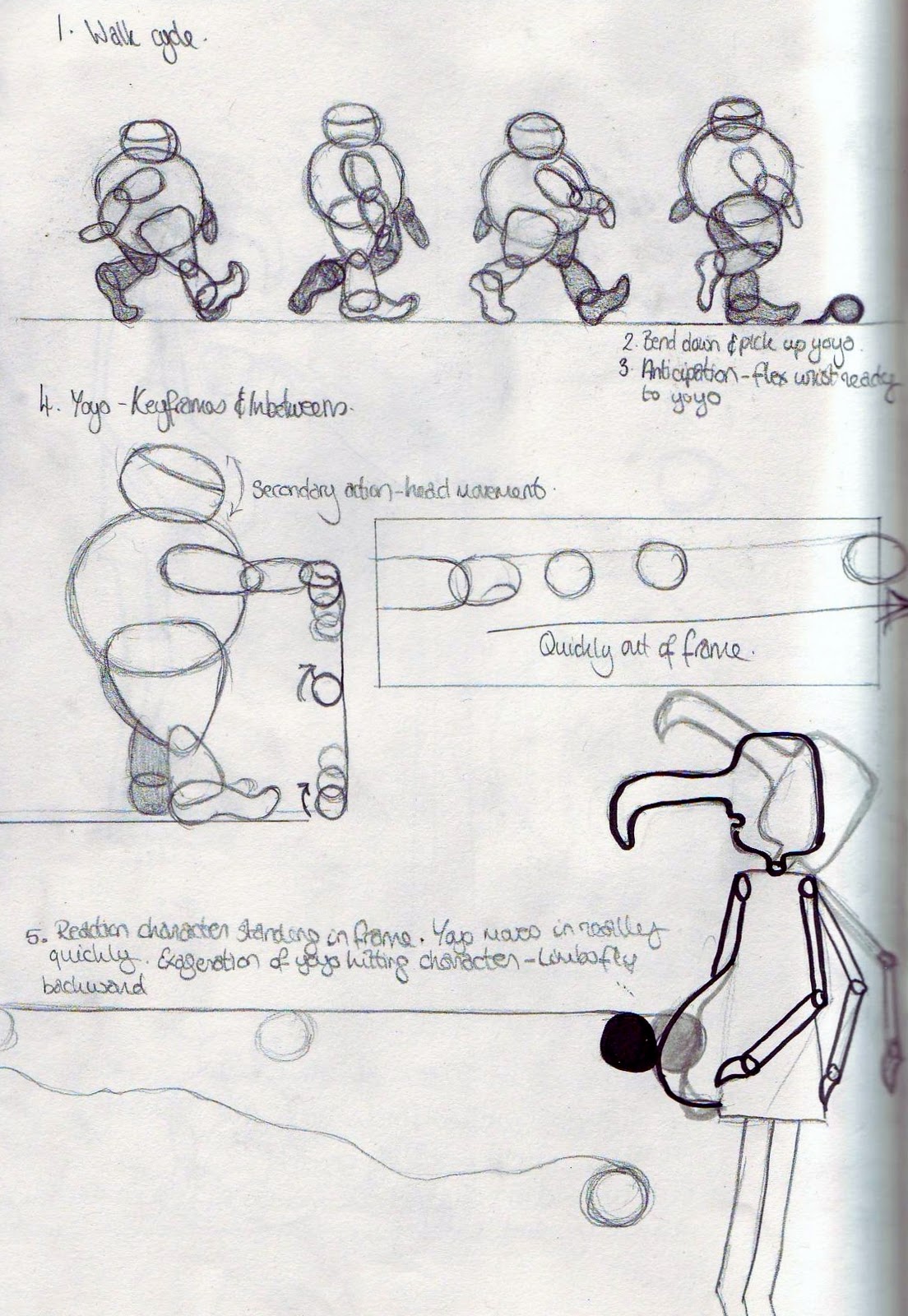 | ||||
| Fig 1 planning the animation |
- Cycle - walk cycle. (see Fig 3) considering weight shift (see Fig 2) helps the understanding of where the head and stomach placement would be, especially considering this character is fat and round.
- Secondary Action - arms move when character is walking (yoyo) head moves in sympathy with arm movement. (Reaction character) when hit with yoyo characters arms and head fly backwards.
- Staging - Camera is at first focused only on character who finds the yoyo, it is only when the yoyo flies out of shot that the camera then switches to the reactionary character making it less obvious what was to happen.
- Anticipation - arm lifts before pushing downwards to use yoyo and arm swings back before throwing yoyo off screen.
- Squash and Stretch/Exaggeration - when yoyo hits reactionary character the stomach squashes but in an over exaggerated way to make the scene look more effective.
- Follow through and overlapping action - when the character stops walking his arm carries on moving. When the yoyo comes back up it carries on travelling upwards after characters arm starts moving downwards again. Characters body has to go back to a resting position after forcing forwards to throw yoyo.
- Timing - yoyo will move at a much faster speed to everything else.
 | ||||||||
| Fig 2 exaggerated weight shift |
 | |||||||||||||
| Fig 3 simple walk cycle |
zoetrope
I have been concentrating so much on examples of walk cycles that I have completely forgotten to look at the obvious. Historically zoetropes are some of the earliest forms of cycles in animation.

Here is my own example from the first week of term:

Here is my own example from the first week of term:
Cycles also work very well with morph sequences, for example in the first week of term we made morph sequences in groups. I also made my own morph and cyclical sequence for the Open Brief and found that cycles in animation are not as limited as I would have believed them to be, managing to combine techniques of hand drawn and pixilation. Personally I find a lot of appeal in cycles, there is something satisfying about watching cleverly considered movements that repeat themselves.
Wednesday, 24 November 2010
Cycles in animation, are they limited to hand drawn pieces?
Looking for examples of cycles in animation I have come across countless pieces that have been hand drawn.
For example here are a few walk, march and run cycles of some well known hand drawn characters which I have taken from http://www.donbluthanimation.com/_Don_Bluth_Animation_Cyber_Garage_Project_march_run_cycles.html


Here are some examples:
1:00 stairs, 1:45 crocodile
running cycle
0:15 eyes, 1:02 stairs, 1:16 chase, 1:50 bookshelf, 2:47 tightrope
A musical parody but it has some good examples of cycles, one of which is the mystery machine cycle with the moving background
scooby and scrappy intro
It's safe to say that there are a LOT of examples in the Scooby Doo cartoons!
Equally I have looked at the Fleischer brother films which due to a similar style to Scooby Doo include a lot of cycles within their work. I came across my first example from the John K blog with an example of Betty Boop http://johnkstuff.blogspot.com/search/label/cycles.
Here are some good Fleischer cycle links:
Nice cycle sequence at 5:43
Cycle sequence at the beginning with example of background movement, walrus
walk sequence at the beginning and spaceship
birds
Good cycle at the beginning with kids on the shoe
These are just examples of two different cartoons, there are many examples out there maintaining the same style and technique with the use of cycles in hand drawn animation.
Looking outside of hand drawn an obvious one to use would be one which we have been shown in Visual Culture created by print work, feet of song.
Similar to hand drawn CG Animation can easily create things such as run and walk cycles, it is stop motion which I have found hard to research.
Here are some examples of walk cycles created using stop motion:
http://www.youtube.com/watch?v=YwcvTeWuxes&feature=related
http://www.youtube.com/watch?v=RGnZZJGaFn0&feature=related
http://www.youtube.com/watch?v=OUk64eUC-DI
However they don't have the obvious cycle quality that hand drawn purveys as Stop motion as a technique is destructive animation and therefore you can not repeat the same thing twice, you can only try to make it look the same.
Looking at some well known films I have come across what are cycles but they don't look the same, they just repeat themselves:
Wallace and Gromit - counting sheep
Coraline - circus mice
I don't think cycles are limited to hand drawn pieces completely but they can't be true cycles outside of this technique.
For example here are a few walk, march and run cycles of some well known hand drawn characters which I have taken from http://www.donbluthanimation.com/_Don_Bluth_Animation_Cyber_Garage_Project_march_run_cycles.html


Listening back to the link on my previous cycle post from Cable Harding he states
Scooby Doo is a prime example of cycles used in cartoons, a lot of this is heavily reliant on the story line as a lot of the time Scooby and the gang find themselves running away from monsters or chasing them instead. This allows the makers at Warner Brother to take advantage of cycling a series of frames saving time and resources.The character will stay in the middle of the frame meanwhile the background will move behind it, it's kind of like Scooby Doo when the mystery machine stayed in the middle of the screen and the back ground moved behind it.
Here are some examples:
1:00 stairs, 1:45 crocodile
running cycle
0:15 eyes, 1:02 stairs, 1:16 chase, 1:50 bookshelf, 2:47 tightrope
A musical parody but it has some good examples of cycles, one of which is the mystery machine cycle with the moving background
scooby and scrappy intro
It's safe to say that there are a LOT of examples in the Scooby Doo cartoons!
Equally I have looked at the Fleischer brother films which due to a similar style to Scooby Doo include a lot of cycles within their work. I came across my first example from the John K blog with an example of Betty Boop http://johnkstuff.blogspot.com/search/label/cycles.
Here are some good Fleischer cycle links:
Nice cycle sequence at 5:43
Cycle sequence at the beginning with example of background movement, walrus
walk sequence at the beginning and spaceship
birds
Good cycle at the beginning with kids on the shoe
These are just examples of two different cartoons, there are many examples out there maintaining the same style and technique with the use of cycles in hand drawn animation.
Looking outside of hand drawn an obvious one to use would be one which we have been shown in Visual Culture created by print work, feet of song.
Similar to hand drawn CG Animation can easily create things such as run and walk cycles, it is stop motion which I have found hard to research.
Here are some examples of walk cycles created using stop motion:
http://www.youtube.com/watch?v=YwcvTeWuxes&feature=related
http://www.youtube.com/watch?v=RGnZZJGaFn0&feature=related
http://www.youtube.com/watch?v=OUk64eUC-DI
However they don't have the obvious cycle quality that hand drawn purveys as Stop motion as a technique is destructive animation and therefore you can not repeat the same thing twice, you can only try to make it look the same.
Looking at some well known films I have come across what are cycles but they don't look the same, they just repeat themselves:
Wallace and Gromit - counting sheep
Coraline - circus mice
I don't think cycles are limited to hand drawn pieces completely but they can't be true cycles outside of this technique.
Thursday, 18 November 2010
walk cycle
Another link to a video...
http://www.youtube.com/watch?v=ePhHDs53lfo
I found this video useful as they break down an animation walk cycle simply into 4 points:
http://www.youtube.com/watch?v=ePhHDs53lfo
I found this video useful as they break down an animation walk cycle simply into 4 points:
- contact
- recoil
- passing
- high point
Subscribe to:
Posts (Atom)